
Welcome to the start of SideQuested: The First Quest! Updates will be posted here on Thursdays. This update contains the full first chapter, while all future updates will be approx 700 words. Updates will be released one week in advance at KB Spangler’s Patreon.
_________________________________________________
Chapter 1: The Workbook
It all started with a book.
I was the kind of feral child who couldn’t read. Couldn’t do much of anything polite, really. No formal education, no social skills more advanced than begging in a vaguely charming manner for food. I could steal, though, and did, my small fingers darting into pockets and purses for the odd coin. It kept me fed, while my niche at the very top of a messenger service’s dovecote kept me dry, if not very warm in winter. But I had a keen sixth sense for danger, and on the day I found the book, I woke knowing it was a day I shouldn’t go stealing.
How? Well, I know now it was my magic making itself known, but back then as a girl of six, or seven, or eight—how strange, to never truly know how old I am—all I knew was that I shouldn’t go a-’thieving in the streets until the morrow. Instead, when I woke that morning and pushed aside the thin wooden board which kept the squawking cloud of grey doves out of my tiny room, I decided to go scrapping instead.
Scrapping is easier than thieving, especially when you’re small and can wriggle through those tight spaces within the piled trash. It’s much more dangerous, though! Nobody disposed of their garbage with safety in mind, and there were…things inside the stacks. If I started the day scrapping with three other children and only two of us came back, nobody asked questions. I only risked scrapping when I had a very bad feeling about thieving.
In Old BlueHouse, the city where I grew up, thieves were never caught twice.
So, a-’scrapping I went. Climbing down, down from that tiny niche that was my whole home, my handholds nothing more than the rough clay of the dovecote’s curved walls. When I got to the ground, I mucked out the dovecote and left the mess in the bucket for the station manager—our arrangement was that I’d keep the place clean and chase the rats away, and he would turn a blind eye to the urchin in his attic. I wasn’t the first to have such a good deal, and I was starting to worry that I wouldn’t have it much longer. I was small for a girl of six (or seven, or eight) but I was starting to outgrow the niche. The manager wouldn’t give me a bigger place to stay just out of kindness, and I was starting to worry.
You don’t think much about the future as a girl of six (or seven, or eight), but you are vaguely aware you want to have one.
Like any other city, Old BlueHouse was a place of highs and lows. I saw the highs, sometimes, glimpses of wealth here and there, but I lived the lows. The streets I walked were thick with rubbish, and I scurried along these in the manner of a stray pet who knew she might be considered some version of prey. I had no real friends, no one I could trust. Older children ran in gangs; younger children were a liability…or worse, something to sell for profit. The kings and queens of Loredan did not permit slavery, but they allowed conditions much like slavery, and no one who could afford a not-slave seemed overly fussed by the distinction. Or so I had heard from those children who had escaped.
Where did I go from here? Where could I go from here?
I knew I was intelligent—part of the reason I had no friends was because other children my age made decisions I thought were childish and I wanted to avoid the very predictable repercussions—but my life was forever fixed on this one day, today, with perhaps a passing thought towards the next.
How did I go from the familiar here to…to a strange and better where?
All of this was one big tangle of emotion in the back of my mind when I found the book.
The junkyard was old and large, and stretched into the city proper because once upon a time it was a goodly distance from the city but then the city grew out and around it. One day the land would become so valuable that the towering mountains of garbage would all be carted up and hauled outside of the city so the process could repeat itself, but until then it was full of buried treasures if you worked for them. I was flat on my belly, wriggling through the stinking castoffs of society’s betters, when I saw the leather spine wedged between the scrap wood. My heart leapt. Books always sold! Even when they were ruined, the scrapman at the end of Hansom Lane would buy them for the paper alone. This one looked to be in fair condition from what I could see of it, but it was properly stuck, wedged tight between chunks of what appeared to have once been a very nice wardrobe before the rain and the rot.
I managed to get a corner of the book free of the mildewed boards, just enough to realize that there was gold stamped on the cover. Gold! I could eat for a week—a month! But the stack of wood groaned in warning, so I forced myself to slow down.
To be careful.
I couldn’t eat if I was dead.
Wiggle it sideways, just a little.
Glance up at the stack of wood.
Wiggle it again, in the other direction.
Back and forth, back and forth…
Almost…
Almost…!
The book slid from between the damp wood and into my eager hands, and I let out a whoop! It was beautiful. Beautiful! It wasn’t a large book, about the size of my two hands held together, and it slowly opened into them. There was no water damage, which surprised me—the old wardrobe looked like it had sat out in the weather for years. The book’s pages were buttery soft, painted with every color I had ever seen, and edged in that gold.
“You’re a treasure,” I told it.
The book moved in my hands.
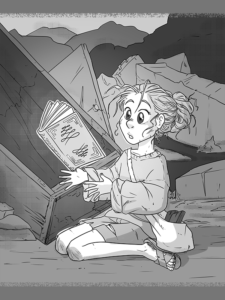
I didn’t gasp. Why would I? I already knew it was magic. And it moved in the same way as the neighborhood’s friendly stray dog did when you went to pet her, pressing itself into my hands as if appreciating my touch. It even hummed very slightly, as if happy.
Then it leapt up and snapped.
There’s no other word to describe such a motion. The book lunged past my face, its cover open wide, and then came the sound of paper cracking against itself with great force. This was blurred within a different sound—a brief but final squeak!—and the sound of claws scrabbling across soggy wood.
The book perched on my shoulder as it dropped the corpse of a gutter snipe in my lap.
I blinked at the snipe. It was half the size of my arm, but size meant nothing when a monster could paralyze you with a scratch. They hunted alone but once they brought down prey, they called the rest of the flock to feed. You weren’t dead when they started eating, either.
I craned my neck to look at the book posed upright on my shoulder. It had begun humming again in a very self-satisfied way, its pages fluffed up like a preening bird.
And I now knew I was going hungry tonight.
This book was mine.